
What Is THCh? The Ultra-Potent Cannabinoid Brands Need to Know

Updated: May 19

Quick Answer: THCh (tetrahydrocannabihexol) is a naturally occurring minor cannabinoid first isolated from cannabis in 2020, distinguished by a six-carbon alkyl side chain that gives it meaningfully stronger CB1 receptor binding than standard Delta-9 THC. It is produced commercially through hemp-derived synthesis and sold in vapes, tinctures, and edibles. Brands sourcing THCh should be aware that federal legislation enacted in November 2025 has significantly shifted the regulatory picture for hemp-derived intoxicating cannabinoids, with new rules taking effect in November 2026.
Key Takeaways
THCh (tetrahydrocannabihexol) is a minor cannabinoid identified in cannabis in 2020, distinguished by a six-carbon alkyl side chain that increases CB1 receptor binding compared to Delta-9 THC.
Although it occurs naturally in cannabis, it exists in trace concentrations below 0.1%, so commercial THCh products are typically synthesized from hemp-derived cannabinoids such as CBD.
The longer side chain allows THCh to interact more strongly with CB1 receptors, placing it between Delta-9 THC and THCp in the potency hierarchy, with estimated effects roughly 10–15x stronger than Delta-9 THC in receptor binding terms.
Because of this potency, THCh is rarely used alone and is usually blended at 5–15% in vape cartridges or formulated at low-milligram doses in edibles and tinctures.
Regulatory risk is evolving: U.S. legislation passed in November 2025 will change hemp definitions and restrict intoxicating hemp cannabinoids starting in November 2026, which could affect THCh product legality.
Partner with Arvida Labs for THCh distillate supply and formulation support, including COA-verified purity, residual solvent testing, batch traceability, and guidance on dosing and blend ratios before product launch.
What is THCh: Structure, Origin, and Why It's Gaining Traction
THCh, formally known as Δ9-tetrahydrocannabihexol, was first isolated from a medicinal cannabis variety in 2020 by a team of Italian researchers led by Dr. Cinzia Citti. This is the same group responsible for identifying THCp the year prior.
The compound was discovered alongside cannabidihexol (CBDh), its CBD-side counterpart, and the findings were published in Scientific Reports. While THCh had been studied in synthetic form as far back as the 1940s, its confirmed presence as a phytocannabinoid in the cannabis plant was only established with that 2020 research.
That discovery is what puts THCh in a category brands should take seriously. It is not a purely manufactured compound invented for the gray market. It has documented phytocannabinoid status, which matters both for formulation credibility and for how regulators are likely to treat it as policies continue to change.
How THCh Differs From THC Structurally
The structural difference between THCh and Delta-9 THC comes down to a single feature: the length of the alkyl side chain attached to the resorcinyl ring. Delta-9 THC carries a five-carbon (pentyl) side chain. THCh carries a six-carbon (hexyl) chain, one additional carbon that meaningfully changes how the molecule interacts with cannabinoid receptors. That extra carbon allows THCh to reach deeper into the CB1 receptor binding pocket and anchor more firmly than its shorter-chain counterpart.

This pattern holds across the THC homolog series. Research on cannabinoid receptor binding shows that alkyl side chain length is one of the primary determinants of binding affinity at CB1, with affinity generally increasing as chain length extends from three carbons up through seven.
THCh sits at six, placing it directly between standard THC (five carbons) and THCp (seven carbons) in both structure and estimated potency. The molecular formula for THCh is C22H32O2, which is a straightforward hexyl homolog of the canonical THC structure, not a synthetic analog or heavily modified derivative.
Is THCh Natural or Synthetic?
This is a question that matters both scientifically and commercially, and the answer requires some precision. THCh does occur naturally in cannabis, but only in trace concentrations below 0.1%. This amount is far too low for any meaningful extraction-based supply. Every commercially available THCh product is therefore produced through synthesis, typically starting from hemp-derived CBD or other hemp-derived intermediates.
Cannabinoids like THCh with non-standard carbon chain lengths are made synthetically rather than extracted from plant material. The natural isolation was a scientific confirmation of its existence, not a production pathway. For brands, this means the quality of THCh is entirely a function of the synthesis process and the lab performing it. Purity levels, residual solvent profiles, and accurate COA documentation are the only reliable indicators of whether what's in the barrel matches what's on the label. This is precisely where supplier selection becomes a make-or-break decision before a single unit goes to market.
THCh Potency and the Receptor Science
Potency claims in the hemp space are frequently overstated, and THCh has not been immune to that problem. Some sources describe it as ten times stronger than Delta-9 THC, others put it at twenty-five times, and the variance isn't accidental.
It reflects a genuine gap between receptor binding data and subjective psychoactive experience, and brands formulating with THCh need to understand both sides of that gap before setting dosing targets or writing product copy.
What the science actually measures is binding affinity, how tightly a cannabinoid molecule attaches to CB1 receptors, not psychoactive intensity in a direct one-to-one sense. Those two things are related, but they are not the same. With that framing in mind, here is what the current data supports and where it still has limits.
CB1 Binding Affinity and Why THCh Hits Differently
At the receptor level, THCh's six-carbon side chain enables it to fit more completely into the CB1 binding pocket than Delta-9 THC's five-carbon chain allows. Laboratory measurements place THCh's CB1 binding affinity at approximately 10% greater than Delta-9 THC based on structural comparisons, though formal Ki binding data for THCh specifically has not been published at the same level of depth as it has for THCp.
Estimates based on the broader THC homolog series and CB1 receptor modeling place THCh somewhere in the 10–15x potency range relative to Delta-9 THC. This is meaningfully stronger, but not at the extreme upper end of what the homolog series can produce.
What makes THCh formulation-relevant is not just the binding strength but the downstream effects of that binding on receptor activation. Research modeling 21 THC analogs against CB1 confirms that side chain length alters both binding geometry and receptor activation patterns.
In simple words, this means that the qualitative character of the effect can shift, not just the intensity. Brands that have worked with THCh report a faster onset relative to standard Delta-9 THC edibles and a duration that extends to the 4–6 hour range in inhalable formats. These are formulation inputs worth building into product positioning and consumer guidance, not afterthoughts.

THCh vs. THCp and Other Ultra-Potent Cannabinoids
Placing THCh accurately in the current potency hierarchy helps brands determine where it fits in their portfolio strategy. Among hemp-derived cannabinoids with documented or estimated CB1 binding data, the ranking looks like this:
THCp: Seven-carbon side chain; binds CB1 receptors with approximately 33x greater affinity than Delta-9 THC; the most potent phytocannabinoid identified to date.
THCh: Six-carbon side chain; estimated 10–15x stronger CB1 binding than Delta-9 THC; more manageable potency profile than THCp with a less extreme dose-response curve.
THCb: Four-carbon chain; Ki of approximately 15 nM at CB1, roughly 3x stronger than Delta-9 THC.
For brands building a tiered product line, or looking to position a high-potency SKU without reaching for the most extreme option in the category, THCh occupies a strategically useful middle tier. It is clearly stronger than Delta-8, noticeably potent compared to Delta-9, but less likely to produce the extended and occasionally overwhelming effects associated with THCp at standard blend concentrations.
THCh Formulation Considerations for Brands
Getting the chemistry right on a THCh product requires more precision than most brands anticipate going in. The same potency properties that make THCh commercially interesting also make dosing errors costly, both for product performance and for consumer trust.
Dosing Windows and Where Brands Get It Wrong
The most common formulation error with ultra-potent cannabinoids like THCh is applying standard THC dosing logic to a compound with a fundamentally different potency profile.
A 10mg Delta-9 THC serving does not translate to a 10mg THCh serving. The receptor binding difference means effects will be disproportionately stronger at equivalent milligram weights.
In vape applications, for example, THCh is typically blended at 5–15% concentration alongside base cannabinoids like Delta-8 or CBD rather than used as a standalone active. This approach distributes the potency effect across a broader cannabinoid profile and gives formulators more control over onset and duration. In edible formats, effective doses tend to be measured in low single-digit milligrams per serving.

Carrier Compatibility and Delivery Format Performance
THCh is lipophilic, meaning its behavior in a finished product is heavily shaped by the delivery format. Not all formats handle it equally well, and the wrong pairing creates problems that no amount of post-production correction can fix. Here is how each major format performs with THCh as an active:
Oil-Based Tinctures: MCT oil and hemp seed oil are both compatible carriers. THCh integrates cleanly at low milligram concentrations, and the lipid matrix supports absorption via sublingual and oral routes. Dosing precision is the primary formulation challenge. Small volume differences at the serving level produce meaningful potency variation, so fill accuracy matters more here than it does with lower-potency cannabinoids.
Vape Cartridges and Disposables: THCh blends without significant viscosity issues at typical 5–15% blend ratios alongside Delta-8 or terpene bases. Residual solvents from the synthesis process will concentrate in the vapor and affect both product quality and third-party lab compliance. A full residual solvent panel on every batch is non-negotiable in this format.
Edibles and Capsules: Oil-based encapsulation is the most reliable approach. Onset is slower than inhalation (typically 45–90 minutes), but duration extends considerably. A relevant factor for sleep and relaxation positioning. Gel cap formats give brands tighter dosing control than infused gummies, where cannabinoid distribution in the batter can vary without precision mixing equipment.
Water-Soluble and Beverage Formats: THCh does not disperse in aqueous systems without emulsification technology. For brands building CBD beverage formulations or water-based products, the emulsification method and droplet size significantly affect bioavailability and stability. Any THCh destined for a water-soluble application needs purity documentation sufficient to confirm the synthesis process did not introduce byproducts that complicate downstream emulsification.
THCh Legal Status and What Brands Need to Know Before Sourcing
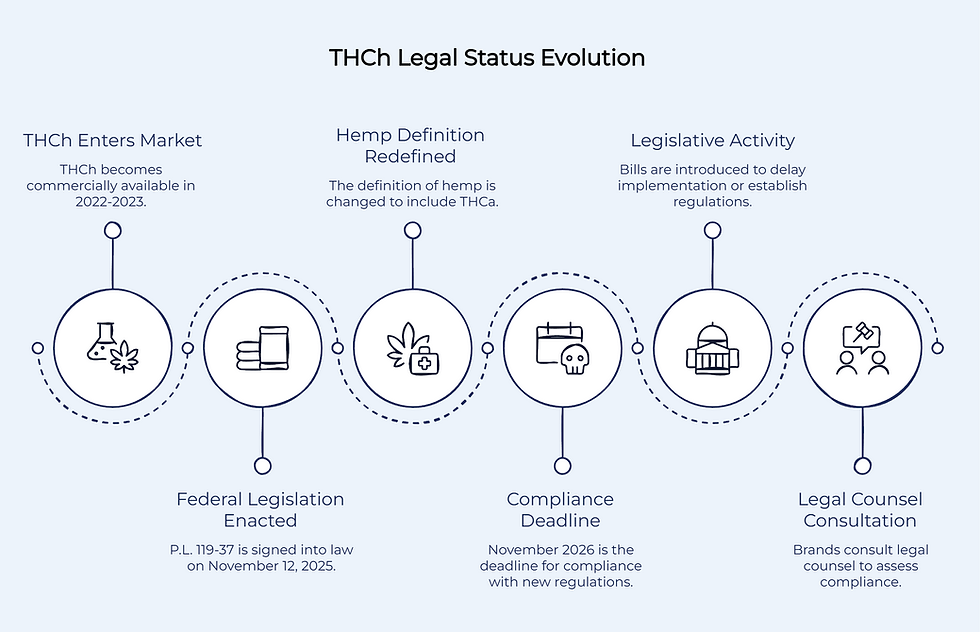
Legal standing for hemp-derived cannabinoids is rarely static, and THCh is no exception. The regulatory environment that existed when THCh entered commercial markets in 2022 and 2023 is materially different from what brands face in 2025 and will face in 2026.
Farm Bill Compliance and the Federal Picture
Federal legislation enacted on November 12, 2025 (P.L. 119-37, Section 781) rewrote the definition of hemp in a way that directly affects products containing THCh and similar intoxicating cannabinoids.
The new law redefines hemp based on total THC concentration, including THCa, rather than Delta-9 THC alone, and introduces new product category restrictions for hemp-derived cannabinoid products. These changes take effect 365 days after enactment, meaning November 2026 is the operative compliance deadline.
As of April 2026, the hemp industry is navigating an active legislative period. Several bills are in circulation, including proposals to delay implementation by three years and others that would establish a full federal regulatory framework with per-serving THC limits.
The Frier Levitt federal hemp redefinition analysis offers one of the more thorough breakdowns of where each proposal currently stands. Brands should be working with legal counsel to assess how their THCh SKUs will be classified under the new definition and what product modifications, if any, are required to maintain compliant status into 2026 and beyond.
Is THCh Right for Your Product Line?
Not every brand has a strategic reason to work with THCh, and knowing when it fits and when it doesn't saves significant time in product development. THCh earns its place in a portfolio when the brand already has a defined high-potency positioning, a consumer base that seeks out stronger experiences, and the formulation infrastructure to handle a sub-milligram-precise active with documentation to match.
Brands still building out their core cannabinoid identity around CBD or CBG are generally better served by establishing that foundation first before layering in ultra-potent minor cannabinoids.
Product Categories Where THCh Performs Best
THCh's potency-to-volume ratio makes it most effective in delivery formats where precision dosing is achievable and where a high-potency effect profile is a feature rather than a liability. Based on how brands are currently formulating with it, these are the categories where it has the most commercial traction:
Vape Cartridges and Disposables: THCh blended at 5–15% with Delta-8 or a terpene-forward base allows brands to market a high-potency effect profile while maintaining formulation control over the overall experience. Fast onset in this format aligns with consumer expectations in the category.
High-Potency Tinctures: At low milligram concentrations per serving (typically 1–3mg THCh per dose), tinctures allow for precise titration and appeal to experienced consumers who have moved past standard Delta-9 or Delta-8 products.
Sleep and Relaxation Edibles: When blended with CBN and a sedative terpene profile, THCh's extended duration in oral formats supports a nighttime positioning that goes beyond what most CBN-only products can deliver.
Effects-Forward Gummies: For brands competing in the premium novelty edible space, THCh in the 2–5mg-per-piece range creates a differentiating potency story, provided the formulation is built around that concentration and not retrofitted from a Delta-9 recipe.
Closing Thoughts on Sourcing and Formulating With THCh at Arvida Labs
THCh is not a cannabinoid for brands that are still figuring out their supplier relationships. Its potency demands precision at every stage, synthesis, purity verification, formulation, and dosing, and the regulatory environment surrounding it is moving fast enough that sourcing from a lab without strong compliance awareness creates real exposure.
For brands that are ready to work with it, the commercial opportunity is genuine: a hemp-derived cannabinoid with a documented potency advantage, clear differentiation from overcrowded Delta-8 categories, and strong fit in high-potency vape and edible formats.
At Arvida Labs, we supply THCh distillate backed by full COA documentation, residual solvent panels, and batch traceability. We work directly with brand partners on formulation strategy, dosing parameters, and blend ratios suited to their specific product format. Whether you are launching your first high-potency SKU or adding THCh to an existing line, our team can walk you through sourcing, compliance considerations, and formulation options before you commit to production.
If THCh is on your product roadmap, now is the right time to get the sourcing and formulation groundwork in place before the November 2026 regulatory deadline reshapes what's available and what's viable in this category.
Looking for a supply and compliance partner to lead your brand in 2026? Partner with Arvida Labs to learn more today.
Frequently Asked Questions About THCh
What Is the Difference Between THCh and THCp?
THCh has a six-carbon side chain and is estimated to be 10–15x stronger than Delta-9 THC at CB1 receptors. THCp has a seven-carbon chain and binds CB1 with approximately 33x greater affinity than Delta-9 THC, making it the more potent of the two. Both are ultra-potent minor cannabinoids used in high-potency vape and edible formulations, but THCp carries a more extreme dose-response curve and a longer average effect duration.
Is THCh Legal to Sell in the United States?
As of April 2026, THCh derived from hemp remains federally compliant under the existing Farm Bill framework, but that framework is changing. Legislation enacted in November 2025 (P.L. 119-37) redefines hemp and restricts intoxicating hemp-derived cannabinoids, with those rules taking effect in November 2026. Several states have already enacted their own restrictions on intoxicating hemp compounds. Brands should consult legal counsel and review their target state market list before launching THCh products.
How Is THCh Made Commercially?
Commercial THCh is produced synthetically from hemp-derived precursors, most commonly using CBD as a starting material. While THCh exists naturally in cannabis, its concentration is under 0.1% — far too low for extraction-based production at any commercial scale. The synthesis process involves constructing the hexyl side chain via chemical reaction and should be followed by thorough purification and third-party testing for purity, residual solvents, and isomer profiles.
What Delivery Formats Work Best With THCh?
Vape cartridges and disposables are currently the most common format, with THCh typically blended at 5–15% alongside base cannabinoids. High-potency tinctures and effects-forward edibles are also viable, with per-serving doses typically in the 1–5mg range depending on the product's intended potency tier. Water-soluble applications are possible but require emulsification technology to address THCh's lipophilic nature.
How Does THCh Appear on Drug Tests?
THCh metabolizes through pathways that produce THC-COOH, the same primary metabolite detected in standard drug screening panels. Brands should communicate clearly that THCh use is likely to produce a positive result on any standard urine or blood-based THC test, regardless of the product's hemp-derived or federally compliant status.
What Should a THCh COA Include?
A complete THCh COA should include cannabinoid potency verified by HPLC, residual solvent testing, a heavy metals panel, microbial testing, and ideally an isomer and byproduct profile specific to the synthesis pathway used. Any supplier that cannot provide all of these panels for a given batch should not be considered a reliable commercial source for a branded product.
Sources for This Article
PubMed: "A novel phytocannabinoid isolated from Cannabis sativa L. with an in vivo cannabimimetic activity higher than Δ9-tetrahydrocannabinol: Δ9-Tetrahydrocannabiphorol (THCP)" - pubmed.ncbi.nlm.nih.gov/33328530/
PMC: "Identification of a new cannabidiol n-hexyl homolog in a medicinal cannabis variety with high CBD content: Cannabidihexol (CBDH)" - pmc.ncbi.nlm.nih.gov/articles/PMC12273586/
ScienceDirect: "Identification of two new phytocannabinoids from Cannabis sativa L.: Cannabidiphorol (CBDP) and Δ9-tetrahydrocannabiphorol (THCP)" - sciencedirect.com/science/article/abs/pii/S246817092400047X
Twenty One Cannabis: "What is THCH? Everything You Need to Know" - twentyonecannabis.com/blog/what-is-thch/
Nature: "A novel phytocannabinoid isolated from Cannabis sativa L. with an in vivo cannabimimetic activity higher than Δ9-tetrahydrocannabinol: Δ9-Tetrahydrocannabiphorol (THCP)" - nature.com/articles/s41598-019-56785-1
Perkins Coie: "Shutdown Legislation Brings New Hemp Rules" - perkinscoie.com/insights/update/shutdown-legislation-brings-new-hemp-rules
DLA Piper: "New federal restrictions on hemp and hemp-derived products: Top points" - dlapiper.com/en-us/insights/publications/2025/11/new-federal-restrictions-on-hemp-and-hemp-derived-products
Frier Levitt: "The Redefinition of “Hemp” Under Federal Law: Regulatory Status, Legislative Developments, and Pending Industry Challenges" - frierlevitt.com/articles/federal-hemp-redefinition-2026-thc-limits-compliance/


Comments