
Cannabinoid Formulation Science: Stability, Degradation, and Effects

Updated: May 19

Quick Answer: Cannabinoid formulation success depends on understanding three interconnected factors: chemical stability under storage conditions, degradation pathways that convert active compounds into unwanted byproducts, and bioavailability enhancement through proper carrier selection.
Research shows CBD can degrade by over 80% within 40 days�at room temperature without proper formulation, while advanced delivery systems can improve oral bioavailability from 6% to over 30%.
Key Takeaways
Cannabinoid product success depends on managing chemical stability, degradation pathways, and bioavailability rather than simply sourcing high-potency raw materials.
Cannabinoids degrade rapidly under heat, light, oxygen, and humidity, with CBD and THC converting into unwanted byproducts that reduce potency and alter effects.
Solubility limits and low natural bioavailability require engineered delivery systems such as lipid carriers, nanoemulsions, SEDDS, or cyclodextrin complexes.
Isolates and distillates behave differently in formulation, affecting crystallization risk, batch consistency, oxidation rates, and dosing precision.
Stability failures typically emerge during storage and distribution, making accelerated stability testing and packaging selection essential before scaling production.
Partner with Arvida Labs�to source high-purity cannabinoids and formulation guidance that help you build stable, bioavailable products without costly reformulation or shelf-life failures.
Potency degradation of 40% within six months. Beverage formulations that separate irreversibly during distribution. Vape cartridge crystallization that renders entire production runs unsalable.�
These product failures all come from formulation decisions made without accounting for cannabinoid molecular behavior under real-world conditions. Access to quality cannabinoids represents only the starting point for product development. Formulators looking to make successful products need to know how these compounds respond to temperature stress, oxidize through specific pathways, and depend on precise delivery mechanisms to achieve bioavailability.�
Three technical factors determine whether cannabinoid products maintain their specifications from manufacturing through end-of-shelf-life: chemical stability protocols, degradation pathway management, and absorption optimization strategies.
The Difference Between Functional and Failed Cannabinoid Products
Cannabinoid product failures rarely manifest during initial development. Separation, potency degradation, and crystallization are a common problem during storage or distribution, often after significant capital investment in production and inventory.�
The gap between simply adding cannabinoids to a carrier and engineering a stable formulation lies in molecular behavior that standard food or beverage chemistry doesn't address.
As a cannabinoid brand, you're more than likely going to encounter these issues:
Solubility Barriers: Cannabinoids are lipophilic molecules with�log P values exceeding 5, creating fundamental incompatibility with water-based systems that requires emulsification chemistry rather than mechanical mixing
Temperature Sensitivity:�CBD exposed to 40�C and 75% relative humidity�converts to cannabielsoin within four weeks, while�THC forms Delta-8-THC and other degradation products�under similar conditions
Material-Specific Behavior:�99% isolates�crystallize under certain conditions, while 85% distillates show batch variability and faster oxidation due to unsaturated compounds
Oxidation Pathways: Unsaturated bonds in cannabinoids react with oxygen, producing color changes and altered pharmacological profiles that affect both product appearance and efficacy
Building Cannabinoid Formulations That Maintain Potency and Performance
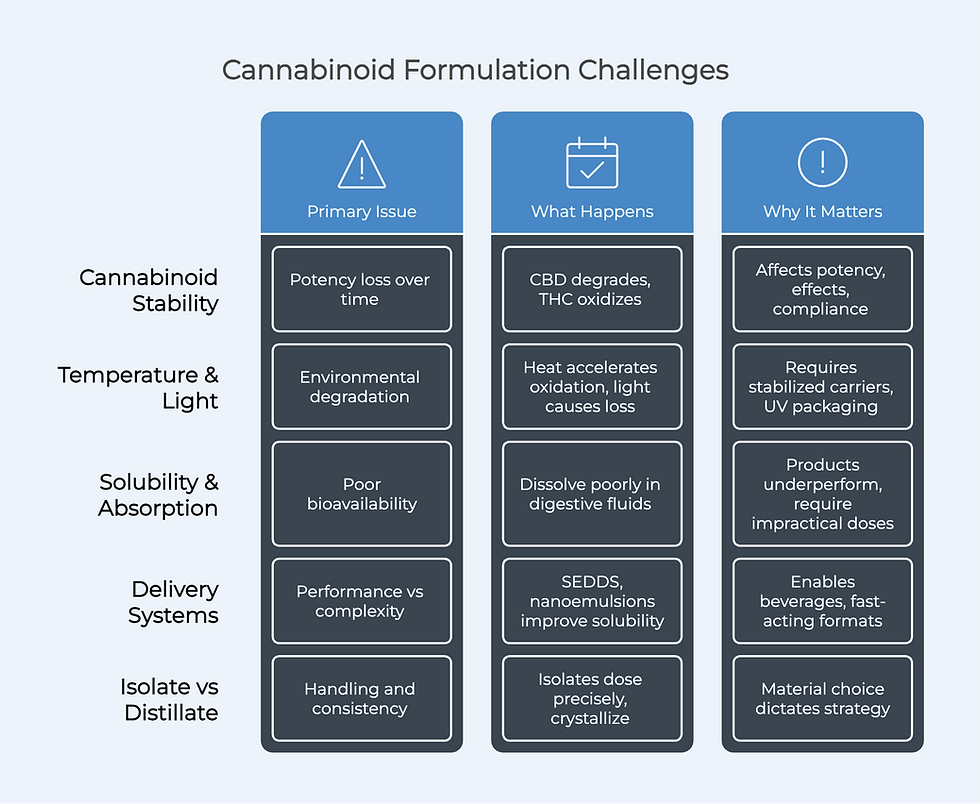
Creating stable, bioavailable cannabinoid products requires addressing four interconnected factors: preventing degradation during storage, enhancing solubility for absorption, selecting appropriate delivery systems, and maintaining quality through production.�
Each factor influences the others, and overlooking any one creates failure points that manifest as inconsistent products.
Cannabinoid Stability and Degradation Pathways
Chemical stability determines whether a product maintains its labeled potency from manufacturing through shelf life.�CBD in e-liquid formulations degrades into cannabielsoin, hydroxy-CBD, and dihydroxy-CBD�under ambient conditions, causing issues that start with potency losses, and continue on to molecular transformations that alter pharmacological profiles.�
THC follows a different route here. Oxidation produces CBN's sedative effects, while acidic environments or heat�create Delta-8-THC and Delta-8-isoTHC, both psychoactive and problematic for brands operating under strict Delta-9 limits.
Temperature drives these degradation rates dramatically.�Unprotected THC degrades completely within 40 days at 20�C, while proper stabilization in carrier matrices retains 80% potency after 300 days.�
Light exposure can make this even more complicated. Even indirect retail display lighting triggers oxidation over weeks, which explains why amber glass and UV-protective packaging represent functional preservation rather than aesthetic choice.
Solubility Limitations and Bioavailability Engineering
The absorption predicament is a matter of simple chemistry. Cannabinoids don't dissolve in digestive fluids.�Unformulated CBD shows below 5% oral bioavailability, meaning products either fail at expected doses or require impractically large servings.�
Simple lipid carriers like MCT oil improve this to 6-13% through lymphatic uptake, but dose-to-dose variability remains high based on what consumers eat beforehand.
SEDDS:�Self-emulsifying drug delivery systems (SEDDS)�is more of an advanced delivery system that spontaneously forms 20-200 nanometer droplets in digestive fluids, increasing surface area and delivering 4.4-fold bioavailability improvements.�
Nanoemulsion:�Nanoemulsion technology�pushes solubility even further up 500% while cutting onset time from 60-120 minutes down to 15-30 minutes, creating clear beverages and rapid-acting tinctures. The trade-off is production complexity requiring specialized equipment and tight process control.
Cyclodextrin Complexation:�Cyclodextrin complexation is another option where cannabinoids are encapsulated within hydrophilic cavities to achieve 5,000 ?g/mL apparent solubility. This allows water-soluble powders and has helped several pharmaceutical companies achieve regulatory approval for cannabinoid medications.

Material Selection: Isolate Vs Distillate Formulation Behavior
Starting material purity fundamentally changes formulation requirements.�CBD isolate at 99% purity�exists as crystalline powder with precise melting points, while�85-90% distillates�remain viscous oils containing minor cannabinoids and terpenes. These different physical states need distinct handling protocols.
Isolates deliver predictable dosing and regulatory compliance. Each gram contains 990+ milligrams with minimal variation but introduces crystallization risks in vape cartridges and tinctures when temperature drops or solvent ratios shift.�
Distillates integrate more readily into oil-based formulations�and resist crystallization through minor cannabinoid content, though batch variability becomes a consideration. A distillate testing at 3% CBG might show 1.5% in the next production run, requiring either extensive batch testing or acceptance of product-to-product variation.
Key considerations when selecting between isolate and distillate:
Isolates excel in precise dosing applications, THC-free requirements, flavor-neutral products, pharmaceutical-grade formulations
Distillates work better for full-spectrum products, vape formulations prone to crystallization, lower-cost production, entourage effect positioning
Hybrid Approaches: Some formulators blend isolates with specific distillates to achieve target cannabinoid ratios while maintaining batch consistency
Testing Requirements: Both require verification, but distillates need more extensive profiling of minor cannabinoid content
Quality Control Markers and Chromatography Impact
Chromatography methods�used in cannabinoid purification determine more than COA potency numbers-they control residual compounds affecting stability and degradation patterns. A�CBG isolate at 97% purity�carries 3% residual material that can catalyze oxidation of the main cannabinoid, significantly reducing shelf life. Brands experiencing unexpected discoloration or potency loss typically trace problems back to source material purity.
COA profiles�reveal formulation compatibility issues before production scale. Distillates showing high acidic cannabinoid levels (THCa, CBDa) require decarboxylation, while residual solvents, even within safety limits, can alter solubility and trigger separation in certain carriers.�
Heavy metals and pesticides pose more than safety risks: transition metals accelerate cannabinoid oxidation, creating color changes, off-flavors, and potency loss that more thorough testing protocols prevent.
Minor Cannabinoid Formulation Challenges
THCp, CBN, and other minor cannabinoids each present unique formulation requirements based on their molecular structure and stability profiles.��
THCp at high concentrations�exhibits different solubility characteristics than CBD or Delta-8, requiring adjusted carrier ratios and sometimes novel delivery systems to maintain stability.
CBN isolate�degrades more slowly than CBD or THC under most conditions, but its lower water solubility requires careful carrier selection for oral products. Because CBN occurs naturally as a THC degradation product, formulations containing both compounds need to account for potential CBN increases over time. This matters for brands making specific ratio claims or targeting particular effects from cannabinoid combinations.
Delta-10 and THCh�introduce additional variables you need to look at. These compounds have shorter track records in commercial formulations, meaning less peer-reviewed stability data exists. Brands developing products with these cannabinoids often need to run extended stability studies to identify degradation patterns and establish realistic shelf life projections.
Development Priorities for Reliable Cannabinoid Products
Successful cannabinoid formulation doesn't start with mixing equipment or packaging design. It begins with strategic decisions about sourcing, testing, and production protocols that prevent the failures discussed throughout this article.�
Brands that consistently deliver stable, effective products follow a specific hierarchy of priorities during development.
Selecting a Cannabinoid Supplier with Verified Purity Standards
Source material quality determines every downstream formulation decision. A supplier providing�CBD isolate�at 99.2% purity creates different formulation requirements than one delivering 97.8% material with unknown residual compounds.�
Arvida Labs�maintains batch-to-batch consistency through controlled extraction and purification protocols, with�COAs�documenting cannabinoid profiles, residual solvents, heavy metals, and microbial content for every production run.
The difference shows up months after launch when competing products experience discoloration or potency loss while yours maintains specifications. Supplier relationships that include formulation consultation, not just transactional bulk sales, provide guidance on carrier compatibility, stability testing parameters, and regulatory documentation that prevents costly reformulation cycles.�
Arvida's white-label partnership program�addresses these technical considerations during product development rather than after market problems emerge.
Implementing Accelerated Stability Testing Before Production Scale
Products that pass initial quality control can still fail during distribution if stability testing doesn't identify degradation patterns early. Accelerated stability studies at 40�C/75% relative humidity reveal problems in weeks that would take months to appear under normal storage. This testing should evaluate potency retention, color stability, separation resistance, and crystallization potential across the product's intended shelf life.
Brands often skip this step to reach the market faster, then face recalls or customer complaints about products that separate, change color, or lose effectiveness. The cost of stability testing represents a fraction of the financial impact from failed product launches or damaged brand reputation.
Matching Delivery Systems to Target Bioavailability
Formulation decisions about carrier systems, particle size, and emulsification methods directly impact product performance. A�beverage requiring rapid onset�needs nanoemulsion technology, while a pharmaceutical application demands the precision of cyclodextrin complexation. Oil-based tinctures offer production simplicity but sacrifice bioavailability and onset speed compared to more sophisticated delivery systems.
This decision affects both manufacturing costs and consumer experience. Products with poor bioavailability require higher cannabinoid doses to achieve effects, increasing ingredient costs while creating variable results. Investing in appropriate delivery technology upfront typically reduces total formulation costs through more efficient cannabinoid utilization.
Establishing Batch Testing and Documentation Protocols
Consistent products require consistent inputs. Every cannabinoid batch should undergo verification testing even when working with trusted suppliers, as extraction variables can create composition differences between production runs. Documentation tracking cannabinoid source, processing parameters, and storage conditions enables rapid troubleshooting when formulation issues emerge.
Brands operating across multiple states face varying regulatory requirements for testing and documentation. Building documentation systems that exceed the strictest state requirements simplifies multi-state expansion and prevents compliance failures during market entry.

Closing Thoughts: How Arvida Labs Supports Formulation Success
Cannabinoid formulation requires more than access to raw materials. It demands understanding molecular behavior under stress, selecting appropriate delivery systems, and maintaining quality through production. Brands succeeding in this market work with�manufacturing partners who control both source purity and formulation chemistry.
Arvida Labs�provides tested cannabinoid isolates and distillates with consistent purity profiles backed by thorough COAs. Whether you're developing a�beverage requiring nano-emulsion technology, a vape product that won't crystallize, or an edible with predictable shelf stability, material quality determines formulation success.
Ready to move beyond trial-and-error product development? Partner with Arvida Labs today�for a reliable cannabinoid supply along with expert advice from some of the best formulators in the world.
Frequently Asked Questions
What Causes CBD Products to Change Color During Storage?
Color changes in CBD products typically result from oxidation reactions forming cannabielsoin and quinone derivatives. These degradation products appear yellow to brown and indicate exposure to heat, light, or oxygen. Products stored in clear containers under retail lighting show faster discoloration than those in amber glass with minimal light exposure. While some color change doesn't necessarily indicate complete potency loss, it signals the degradation process has begun.
Can Cannabinoid Degradation Products Cause Unexpected Effects?
Yes. CBD can convert to psychoactive compounds, including Delta-8-THC, under acidic conditions, while THC oxidizes to CBN, which produces sedative effects. Products stored improperly or past their stability window may produce different effects than intended in the original formulation. This is why stability testing and proper storage conditions matter for both efficacy and safety.
Why Do Some Vape Cartridges Crystallize While Others Don't?
Crystallization occurs when cannabinoid concentration exceeds solubility limits in the carrier at storage temperature. High-purity isolates crystallize more readily than distillates containing minor cannabinoids and terpenes. Crystal-resistant formulations use specific cannabinoid-to-carrier ratios, temperature control, or additives that prevent molecular organization into solid structures. The same cannabinoid at the same concentration can remain stable or crystallize depending on carrier selection.
How Much Does Bioavailability Really Matter for Oral Products?
Bioavailability determines effective dose. A product with 5% bioavailability requires 20 times more cannabinoid than one achieving 100% bioavailability to deliver the same blood concentration. For brands, this affects both cost and consumer experience. Products with poor bioavailability need higher doses, larger serving sizes, and create more variable effects between users. Enhanced bioavailability formulations cost more to produce but require less active ingredient per dose.
What's the Difference Between Nano-Emulsions and Standard Oil Suspensions?
Nano-emulsions create droplets under 200 nanometers that remain stably dispersed in water-based products, dramatically increasing surface area for absorption. Standard oil suspensions separate from water and rely on dietary fat for absorption. Nano-emulsions typically show faster onset (15-30 minutes vs 60-120 minutes) and higher bioavailability, but require specialized production equipment and more complex formulation chemistry.
Do Minor Cannabinoids Require Different Formulation Approaches Than CBD or THC?
Yes. THCp, CBN, and other minor cannabinoids each have distinct solubility, stability, and crystallization behaviors. A formulation optimized for CBD won't necessarily work for THCp, which requires different carrier ratios. Successful minor cannabinoid products typically involve stability testing specific to that compound rather than assuming major cannabinoid formulations will translate directly.
How Long Should Properly Formulated Cannabinoid Products Remain Stable?
Stability depends on storage conditions, packaging, and formulation quality. Products in protective packaging stored at room temperature should maintain 90%+ labeled potency for 12-24 months. Products exposed to heat, light, or stored in permeable containers may degrade significantly within 3-6 months. Accelerated stability testing at 40�C/75% RH helps predict real-world shelf life before products reach market.
Sources for This Article
ScienceDirect: "Nanoemulsions as a strategy for the oral delivery of cannabidiol: A review" - sciencedirect.com/science/article/abs/pii/S1773224723011681
Nature: "Development of a self-nanoemulsifying drug delivery system (SNEDDS) for oral delivery of cannabidiol (CBD)" - nature.com/articles/s41598-022-23910-6
ScienceDirect: "Cannabidiol (CBD) in food: A review of its pharmacokinetics, pharmacology, and safety" - sciencedirect.com/science/article/pii/S2211715622001849
Drug Development & Delivery: "FORMULATION DEVELOPMENT - Understanding CBD Formulation Versus Dosage Format" - drug-dev.com/formulation-development-understanding-cbd-formulation-versus-dosage-format/
PMC: "The Pharmacokinetics and Pharmacodynamics of Cannabidiol-Based Products: A Review" - pmc.ncbi.nlm.nih.gov/articles/PMC10572536/
Emergen Research: "Cannabis Beverages Market" - emergenresearch.com/industry-report/cannabis-beverages-market


Comments