
CBD vs CBG: Which Cannabinoid Fits Your Formulation Goals?


Quick Answer: Choose CBD when you need a stable, cost-effective, shelf-friendly cannabinoid for broad wellness use cases like baseline anxiety, daily stress, and chronic inflammation. Choose CBG when you want a faster-onset, clearer functional effect that fits daytime pain, tension, focus-support, and ‘feel it sooner’ positioning, but expect higher cost and tighter oxidation and stability controls.
For most brands, the winning play is CBD as the base with CBG as the differentiator (often 3:1 to 5:1 CBD:CBG) to get noticeable performance without blowing up COGS.
Key Takeaways
CBD and CBG differ by only two hydrogen atoms, but this changes stability, solubility, shelf life, and how each cannabinoid behaves in large-scale formulations.
CBD works indirectly through FAAH inhibition and serotonin (5-HT1A) modulation, producing slower-onset, longer-lasting effects suited for baseline anxiety and chronic inflammation products.
CBG acts more directly on CB2 and alpha-2 adrenergic receptors, delivering faster onset and clearer analgesic effects that fit acute pain, tension, and daytime functional formulations.
CBD is more cost-effective and stable at high concentrations, while CBG commands a 15–30% price premium and requires tighter oxidation control and lower formulation concentrations.
Brands choosing the right cannabinoid upfront reduce failed launches, shelf-life losses, and expensive reformulation cycles tied to mismatched effects or cost overruns.
To source high-purity CBD and CBG isolates with formulation guidance and compliant documentation, contact Arvida Labs and bring your formulation goals to market with confidence.
A brand launches its first CBD anxiety gummy. Six months later, they're reformulating with CBG after customer feedback reveals the product doesn't deliver the calming effects they promised.
Another company develops a premium pain relief topical using expensive CBG isolate, only to discover that CBD would have provided better anti-inflammatory results at half the cost. These are hypothetical scenarios, but they represent the costly reality facing brands that treat cannabinoid selection as an afterthought rather than a strategic foundation.
The difference between CBD and CBG determines everything from manufacturing costs to product efficacy. CBD works through indirect pathways that take longer to manifest but provide sustained relief, ideal for baseline anxiety management and chronic inflammation.
CBG targets receptors directly, creating a faster onset but requiring more precise dosing and careful formulation. One isn't inherently better than the other. They're simply built for different applications, and choosing the wrong one for your target effect means reformulating from scratch after your first production run fails to meet customer expectations.
This guide breaks down exactly when to use CBD, when CBG makes more sense, and how to combine both cannabinoids for products that deliver measurable results while controlling costs. The choice you make before your first batch determines whether your product succeeds or becomes another cautionary tale about expensive reformulation.
CBD vs CBG: Complete Breakdown
The fundamental differences between CBD and CBG start at the molecular level and extend through production economics, regulatory status, and practical formulation considerations. Each factor affects not just what you can create, but
how reliably you can scale it.

Chemical Structure and Molecular Differences
CBD (C21H30O2) and CBG (C21H32O2) differ by just two hydrogen atoms, but this structural variation fundamentally alters their stability and formulation behavior.
CBD resists oxidation better, achieving 18-24 month shelf lives with standard packaging. CBG requires amber glass and nitrogen flushing to maintain potency beyond 12-18 months due to increased oxidation susceptibility.
These differences impact formulation directly. CBD dissolves in MCT oil up to 100mg/ml without crystallization, while CBG requires lower concentrations (60-80mg/ml) or emulsifiers to prevent separation. For shelf-stable products, these considerations determine whether your batch maintains label claims or fails testing six months post-manufacture.
Endocannabinoid System Interactions
CBD operates as an indirect modulator, inhibiting FAAH enzyme activity to increase anandamide levels. Research shows this mechanism contributes to anxiolytic effects through 5-HT1A receptor activation, with effects building gradually over 30-60 minutes, which is ideal for sustained-release formulations.
CBG takes a more direct approach. Studies demonstrate CBG acts as a partial CB2 agonist while functioning as an alpha-2 adrenergic receptor agonist, triggering beta-endorphin release. This direct receptor activity explains faster onset times (15-30 minutes) reported with CBG in transdermal and sublingual formats.
Why does this matter? CBG suits acute symptom relief (breakthrough pain, panic attacks), while CBD provides stable baseline effects for chronic condition management (generalized anxiety, inflammation).
Effects and Therapeutic Mechanisms
CBD and CBG produce distinct effects despite both being non-psychoactive. Research on CBD dosing shows therapeutic benefits become evident at doses of 300mg or higher for anxiety, though full-spectrum formulations demonstrate effects at lower doses (~30mg daily) compared to CBD isolate (300mg daily).
CBD primarily generates calming, anti-anxiety effects without sedation at lower doses (10-30mg), while higher doses (50-100mg+) may promote relaxation.
Clinical trials indicate anxiolytic effects with acute CBD administration, with users reporting mental clarity and physical ease suitable for daytime wellness applications.
CBG produces more subtle effects with a faster onset than CBD in sublingual formats. Preclinical research demonstrates CBG's activity at CB2 receptors and alpha-2 adrenergic receptors creates analgesic effects distinct from CBD's anti-inflammatory pathways.
Users describe CBG as producing "clear-headed calm" without drowsiness, gently alerting without stimulation, making it appropriate for morning and midday formulations targeting physical tension without affecting productivity.
When combined, CBD and CBG create complementary effects addressing both mental and physical aspects of stress. Studies on multi-cannabinoid formulations suggest synergistic activity when cannabinoids target different receptor systems.
CBD handles anxiety through serotonin modulation, while CBG addresses physical discomfort through direct receptor agonism. This mechanistic synergy explains why 3:1 and 5:1 CBD:CBG ratios perform well in wellness formulations designed for daytime use.

Regulatory Status and Compliance Requirements
Both CBD and CBG derived from hemp with less than 0.3% Delta-9 THC fall under 2018 Farm Bill protections federally, though state-level implementation varies.
Some states effectively ban all cannabinoids, while others provide clear regulatory pathways. Compliance centers on testing requirements: cannabinoid potency, heavy metals, pesticides, residual solvents, and microbial contamination.
COA documentation requires batch-specific testing confirming CBD or CBG content while verifying the absence of THC conversion byproducts. CBD testing protocols are well-established with competitive rates ($100-300 per panel), while CBG testing may encounter delays at smaller laboratories unfamiliar with CBG reference standards.
Typical Dosage Ranges and Concentration Guidelines
CBD dosing in commercial products ranges from 10-50mg per serving for general wellness applications, with higher concentrations (50-100mg+) reserved for specific therapeutic targets like chronic pain or severe anxiety.
Clinical research published in Communications Medicine used approximately 30mg of CBD delivered three times daily (90mg total daily dose) for anxiety management, establishing dosing benchmarks that many brands adopt.
The challenge with CBD lies in its biphasic dose-response curve. Lower doses (10-30mg) often produce stimulating or neutral effects, while higher doses (50-100mg+) generate sedating outcomes. Brands must calibrate dosing based on the intended use case.
CBG research remains in earlier stages, but emerging data suggest effective doses may be lower than CBD equivalents. Studies on CBG's analgesic properties show significant pain reduction at doses of 10-25mg in animal models, with transdermal application requiring even less systemic exposure.
Brands currently marketing CBG products formulate between 10-30mg per serving, often combining CBG with CBD to trigger synergistic effects while managing costs. The lower effective dose of CBG partially offsets its higher per-milligram cost, making mixed formulations economically viable.
Cost Analysis: Bulk Pricing and Formulation Economics
CBD isolate wholesale pricing ranges $450-700/kg, depending on volume. Brands ordering 6-10kg pay $600-700/kg, while 50kg+ orders secure $450-500/kg.
A 25mg CBD dose costs $0.01-0.02 in raw ingredients. CBG commands $600-900/kg due to production scarcity, translating to $0.015-0.025 per 25mg dose. Hemp Benchmarks data shows CBG maintains a 15-30% price premium over CBD.
For high-dose products, a 100mg CBD capsule costs $0.05-0.08 in cannabinoid content versus $0.08-0.12 for CBG. At 100,000 units monthly, this adds $3,000-4,000 in ingredient costs.
Smart brands use CBD as the primary cannabinoid with smaller CBG amounts. 75mg CBD plus 25mg CBG costs $0.06-0.09 per dose, delivering differentiation while controlling costs.
CBD Pricing Tiers: 1-5kg ($650-750/kg), 6-20kg ($550-650/kg), 50kg+ ($400-500/kg)
CBG Pricing Tiers: 1-5kg ($800-900/kg), 6-20kg ($700-800/kg), 50kg+ ($575-675/kg)
Per-Dose Comparison: 25mg CBD = $0.01-0.02; 25mg CBG = $0.015-0.025
CBD vs CBG: Applications Across Anxiety, Pain, and Sleep
The theoretical differences between CBD and CBG become most relevant when examining specific health applications where clinical evidence, mechanism of action, and formulation requirements converge.
Anxiety relief, pain management, and sleep support represent the three largest product categories in the cannabinoid wellness market, and each demands different cannabinoid selection strategies.

Anxiety Relief: Clinical Evidence and Formulation Strategies
A 2024 systematic review found that CBD demonstrates a substantial impact on anxiety (Hedges' g = -0.92), while Dana-Farber clinical research showed significantly lower anxiety levels three hours post-dose versus placebo. CBD operates through 5-HT1A receptor agonism, which is the same serotonin system targeted by prescription anxiolytics.
Effective CBD dosing ranges from 10-50mg, depending on severity. Sublingual tinctures peak within 30-45 minutes for anticipatory anxiety, while oral formats provide a 4-6 hour duration for baseline reduction.
CBG's anxiolytic role remains less validated. Research indicates GABA uptake inhibition similar to prescription anxiolytics, but evidence comes primarily from preclinical models. Multi-cannabinoid formulations combine CBD and CBG in 3:1 to 5:1 ratios, with brands reporting optimal results using 30-40mg CBD plus 10mg CBG for acute anxiety, or 15-20mg CBD plus 5mg CBG for maintenance.
Pain Management: Anti-Inflammatory Vs Analgesic Mechanisms
CBD's anti-inflammatory pathways, COX-2 enzyme inhibition, and cytokine reduction make it effective for arthritis and inflammatory conditions. Topical formulations deliver 50-100mg directly to affected areas without systemic absorption, while oral CBD requires 50-100mg for widespread inflammatory conditions.
CBG activates TRPV1 receptors to block pain signaling while stimulating CB2 receptors for beta-endorphin release. Studies on neuropathic pain show CBG attenuates hypersensitivity through alpha-2 adrenergic activity, which is absent in CBD.
Sleep Support: Where Both Cannabinoids Fall Short
CBD's relationship with sleep is paradoxical. Low doses (10-25mg) often produce alerting effects, while higher doses (50-100mg+) promote sleep readiness by reducing underlying anxiety. Research shows CBD improves sleep quality by addressing conditions disrupting sleep rather than directly inducing it.
CBG's sedative potential remains preliminary, supported by anecdotal reports rather than controlled studies. CBN outperforms both cannabinoids for sleep applications, demonstrating true sedating properties at 5-15mg. Successful formulations use CBN as the primary ingredient (10-15mg) supported by CBD (10-20mg) for anxiety reduction.
The most effective products combine cannabinoids with proven sleep aids. 10-15mg CBN, 15-25mg CBD, 200-400mcg melatonin, and 100-200mg magnesium glycinate.
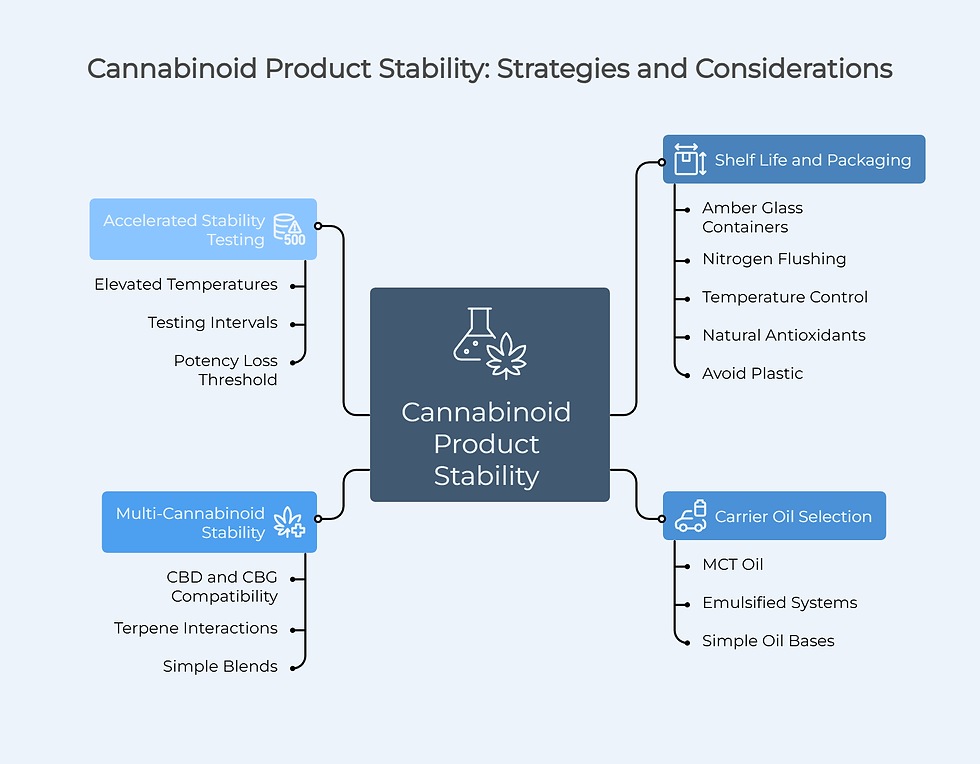
Formulation Strategies and Stability Considerations
Formulation chemistry determines whether your product maintains label claims from manufacturing through expiration dating. Cannabinoid degradation, oxidation, and carrier incompatibility create the most common causes of product failure in post-market testing. Issues that cost brands significantly more than proper formulation design during development.
Shelf Life and Packaging Requirements
Shelf life projections for cannabinoid products depend primarily on storage conditions and packaging design.
Packaging guidelines for optimal cannabinoid stability include:
Amber Glass Containers: Essential for both CBD and CBG to block UV light degradation
Nitrogen Flushing: Recommended for CBG products during bottling to displace oxygen
Temperature Control: Store CBD at 60-75°F; CBG requires 40-60°F for maximum shelf life
Natural Antioxidants: Vitamin E or rosemary extract can slow CBG oxidation, but require stability testing
Avoid Plastic: HDPE and PET allow oxygen permeability, reducing shelf life by 30-40%
CBG faces even stricter stability requirements. Its chemical structure makes it more susceptible to oxidation than CBD, and exposure to heat or light can reduce CBG content by 15-25% over 6 months in poorly packaged products.
Carrier Oil Selection and Bioavailability
Carrier oil selection affects both cannabinoid stability and bioavailability. MCT oil remains the industry standard for internal products. CBD and CBG dissolve readily in MCT, the carrier remains stable for 18+ months, and MCT enhances cannabinoid absorption compared to olive oil or hemp seed oil.
For topical applications, emulsified systems using lecithin or polysorbate improve skin penetration by creating smaller particle sizes that pass through the stratum corneum more effectively. Formulations using simple oil bases (coconut oil, shea butter) provide inferior transdermal delivery despite their appeal in "natural" product marketing.
Multi-Cannabinoid Stability and Complexity Management
Multi-cannabinoid formulations require additional stability considerations. CBD and CBG remain chemically compatible and don't interact in ways that reduce stability or potency.
However, adding terpenes or other botanical extracts can introduce compounds that compete for space in oil carriers or create oxidative stress. Our experience of working with brands with custom cannabinoid blends shows that keeping formulations relatively simple, 1-3 cannabinoids plus a carefully selected carrier, produces more stable products than complex multi-ingredient blends where interactions become difficult to predict or test.
Accelerated Stability Testing Protocols
Brands should conduct accelerated stability testing before full-scale production. Store samples at elevated temperatures (40°C/104°F) for 4-6 weeks, which approximates 12-18 months of room-temperature aging. Test cannabinoid content at 0, 2, 4, and 6 weeks to model degradation rates and set realistic expiration dates.
Products losing more than 10% potency during accelerated testing need formulation adjustments, different carriers, antioxidant additions, or packaging improvements, before commercial launch.
Closing Thoughts: How Arvida Labs Supports CBD and CBG Product Development
The choice between CBD and CBG isn't always binary. The most successful brands in the cannabinoid wellness space understand that cannabinoid selection, sourcing reliability, and formulation expertise work together to create products that deliver consistent results batch after batch.
Arvida Labs manufactures both CBD isolate and CBG isolate to 98%+ purity standards, with full batch documentation and third-party testing that meets the most stringent compliance requirements.
Beyond raw ingredients, we provide formulation consultation for brands developing anxiety, pain, or sleep-focused products, helping you select the right cannabinoid ratios for your target application while managing per-dose costs and meeting stability requirements for your desired shelf life.
Whether you're launching your first CBD product line or adding CBG formulations to an existing catalog, the technical details matter. Our white-label services support brands that need turnkey solutions, while bulk cannabinoid supply serves manufacturers with in-house production capabilities.
Ready to develop your CBD or CBG product line? Contact Arvida Labs today to bring your formulation to market with expert support.
Frequently Asked Questions
Can You Combine CBD and CBG in the Same Formulation?
Yes, CBD and CBG are chemically compatible and work synergistically. Brands commonly use 3:1 to 5:1 (CBD:CBG) ratios for anxiety and pain products. The cannabinoids target different pathways—CBD's 5-HT1A modulation plus CBG's alpha-2 adrenergic activity creates complementary effects. Stability testing shows CBD+CBG blends maintain potency equivalently to single-cannabinoid products when properly formulated and packaged.
How Do CBD and CBG Differ in Bioavailability?
Both face similar oral bioavailability challenges. First-pass metabolism reduces absorption to 15-20%. Sublingual delivery improves both to 25-35%. CBG shows greater sensitivity to carrier selection. Emulsified systems improve CBG absorption 30-40% versus 15-20% for CBD. Transdermal delivery slightly favors CBD's smaller molecular structure for topical penetration at equivalent concentrations.
Which Cannabinoid Is Better for First-Time Product Developers?
CBD presents fewer obstacles. Established supply chains provide reliable sourcing, consumers understand CBD's benefits, retailers stock products without extensive education, and clinical research supports efficacy claims. New brands enter the market faster with CBD while learning formulation and compliance. Once established, adding CBG line extensions becomes more feasible with the existing customer base and production workflows.
How Stable Are CBD and CBG in Different Carrier Oils?
MCT oil provides optimal stability. CBD maintains 95%+ potency for 18-24 months, CBG for 12-18 months. Hemp seed and olive oils degrade faster due to unsaturated fat oxidation, reducing shelf life 20-30%. For topicals, emulsified carriers using lecithin improve stability versus straight oils. Water-based formulations require preservatives and maintain stability for only 6-9 months.
Sources for this Article
MDPI: "The Impact of Cannabidiol Treatment on Anxiety Disorders: A Systematic Review of Randomized Controlled Clinical Trials" - mdpi.com/2075-1729/14/11/1373
ASPET Journals: "The Pharmacological Case for Cannabigerol" - jpet.aspetjournals.org/content/376/2/204
Hemp Benchmarks: "March 2024 Hemp Spot Price Index Report" - hempbenchmarks.com/hemp-market-insider/march-2024-hemp-spot-price-index-report/
PMC (PubMed Central): "The safety and efficacy of low oral doses of cannabidiol: An evaluation of the evidence" - pmc.ncbi.nlm.nih.gov/articles/PMC9841308/
Nature: "Clinical and cognitive improvement following full-spectrum, high-cannabidiol treatment for anxiety: open-label data from a two-stage, phase 2 clinical trial" - nature.com/articles/s43856-022-00202-8
Journal of Clinical Medicine Research: "Dosage, Efficacy and Safety of Cannabidiol Administration in Adults: A Systematic Review of Human Trials" - jocmr.org/index.php/JOCMR/article/view/4090/25893083
PubMed Central: "Cannabigerol (CBG): A Comprehensive Review of Its Molecular Mechanisms and Therapeutic Potential" - pmc.ncbi.nlm.nih.gov/articles/PMC11597810/
ScienceDirect: "NMNAT2: An important metabolic enzyme affecting the disease progression" - sciencedirect.com/science/article/pii/S0753332222015529
Dana-Farber Cancer Institute: "Trial of CBD for cancer-related anxiety demonstrates intriguing findings" - dana-farber.org/newsroom/news-releases/2024/trial-of-cbd-for-cancer-related-anxiety-demonstrates-intriguing-findings
Recovered.org: "Cannabigerol (CBG): Therapeutic Potential and Safety Profile" - recovered.org/marijuana/cbg
PubMed: "Cannabigerol (CBG) attenuates mechanical hypersensitivity elicited by chemotherapy-induced peripheral neuropathy" - pubmed.ncbi.nlm.nih.gov/35899583/


Comments