
How Is CBN Made: The Chemistry, Production Methods, and What It Means for Formulations


Quick Answer: CBN (cannabinol) is produced through the oxidative degradation of THC, either naturally over time or through controlled lab processes. At commercial scale, manufacturers convert hemp-derived CBD or CBG into CBN using isomerization and enzymatic methods, then refine the output into a high-purity isolate through distillation and chromatography. For brands sourcing bulk CBN, the production method and purification rigor directly determine purity, consistency, and regulatory compliance.
Key Takeaways
CBN does not occur in meaningful amounts in hemp; it forms through oxidative degradation of Δ9-THC, first converting to cannabinolic acid (CBNa) and then to CBN via decarboxylation.
Natural aging is commercially impractical, as THC degrades slowly and unpredictably, making controlled lab-based conversion the primary production method for bulk CBN.
Most commercial CBN is produced from hemp-derived CBD through iodine-catalyzed isomerization, avoiding THC intermediates and maintaining Farm Bill compliance.
Alternative production routes include controlled THC oxidation and CBGa-based enzymatic conversion, each differing in regulatory positioning, cost, and byproduct profile.
Crude CBN extract undergoes distillation, winterization, chromatography, and crystallization to achieve 98–99%+ isolate purity with non-detectable THC and full-panel third-party COAs.
A 2024 double-blind, placebo-controlled study found 20mg CBN reduced nighttime awakenings without increasing daytime fatigue, supporting its positioning in sleep formulations.
Partner with Arvida Labs to source 99%+ purity, batch-traceable CBN isolate backed by full-panel COAs and formulation support for compliant, sleep-focused product development.
Most cannabinoid buyers already know the basics: CBD and CBG come straight from the plant, isolate is the purified form, and purity is what you pay for. CBN breaks from that pattern entirely. It doesn't grow in the hemp plant in any meaningful quantity. It isn't produced by an enzyme, and it can't be selectively bred into a strain.
It forms after THC degrades. It’s a chemical afterthought that took nearly a century of research to position as a marketable ingredient.
That origin story has real consequences for sourcing. Brands that don't understand how CBN is actually made tend to evaluate it the same way they evaluate CBD: purity percentage, price per gram, and whether the COA looks clean. But CBN's production complexity runs deeper than that.
The starting material, the conversion method, and the number of purification passes all affect what ends up in your formula and whether it will hold up batch to batch. This article walks through the chemistry of CBN formation, the three commercial production routes used today, and what to look for when you're qualifying a supplier.
CBN Is Not Made Like Other Cannabinoids
Most cannabinoids follow a predictable biosynthetic path inside the hemp plant. CBG forms first from CBGa, then enzymatic activity converts it into THC, CBD, CBC, and other compounds. CBN does not follow this route at all. It is the only major cannabinoid that does not originate from a plant enzyme. Instead, it forms after the fact as a byproduct of THC breaking down under environmental stress.
That distinction shapes everything about how CBN is sourced, produced, and evaluated at scale. Here's how CBN differs from the cannabinoids most formulators are already familiar with:
Origin: CBD, CBG, and CBC are all produced enzymatically inside the living plant from CBGa. CBN is produced post-harvest through the oxidative degradation of THC. The plant plays no direct role in making it.
Natural Concentration: Freshly harvested cannabis contains less than 1% CBN. CBD can exceed 20% in purpose-bred hemp strains. The difference in natural abundance is the reason CBN costs more per gram at comparable purity levels.
Production Pathway: CBD and CBG can be extracted directly from biomass. CBN requires a chemical conversion step, either controlled oxidation or isomerization, before it can be refined into isolate.
Regulatory Starting Material: Because CBN derives from THC degradation, the compliance profile of the production process depends heavily on what material the conversion starts from. Hemp-derived CBD as a feedstock keeps the process Farm Bill-compliant. THC-rich cannabis does not.

The Role of THC Oxidation
CBN is unique among phytocannabinoids in that its biosynthetic pathway involves conversion directly from Δ9-THC, rather than from an acidic precursor like THCa or CBGa.
When THC is exposed to oxygen, heat, or ultraviolet light, it first converts to cannabinolic acid (CBNa). From there, decarboxylation, the same process that activates most cannabinoids, converts CBNA into CBN.
The molecule that emerges is structurally similar to THC but has lost much of its psychoactive potency through aromatization of its cyclohexyl ring.
What that means practically is that CBN is THC that has fully oxidized and stabilized. It retains a weak affinity for CB1 receptors, roughly 10% of THC's binding strength, while showing comparatively stronger activity at CB2 receptors, which are associated with immune function rather than psychoactivity. This is part of why CBN's effect profile reads as relaxing rather than intoxicating at standard doses.
Why Natural Aging Doesn't Scale
The natural pathway to CBN is slow and uncontrolled. A United Nations study found that THC potency decreases by roughly 50% over four years as it oxidizes into CBN. This makes natural production completely impractical for commercial use. Yields are unpredictable because CBN concentration depends on storage conditions, humidity, light exposure, and the starting THC content of the biomass. Running a formulation-grade ingredient supply chain around aged cannabis is not a viable model.
That's why virtually all commercially available CBN today is lab-produced. The challenge is converting precursor cannabinoids into CBN efficiently, with high yield, and without introducing unwanted byproducts or regulatory complications. That brings us to the three methods the industry has converged on.
How CBN Is Produced at Commercial Scale
Brands building sleep-focused gummies, nighttime tinctures, or relaxation capsules need a consistent, documented, THC-compliant ingredient. None of that is possible when your supply depends on how long someone left a batch of cannabis sitting in a warehouse.
The production methods below represent the current state of commercial CBN manufacturing. Each has tradeoffs in yield, starting material cost, regulatory positioning, and residual byproduct profile.
Controlled THC Oxidation
The most direct method mirrors what happens naturally, but with lab controls applied. Processors expose THC-rich extract to oxygen and elevated heat, or UV light, in a controlled environment over a compressed timeline.
Some patented methods convert THC to CBN by applying heat in the presence of oxygen over multiple days, accelerating what would otherwise take years. Higher temperatures above 150°C can increase CBN yield in biomass and may also serve as a THC remediation method for material that exceeds the 0.3% delta-9 limit.
The limitation here is feedstock compliance. Starting with THC-rich material requires handling material that is federally controlled, which restricts which facilities can run this process and in what states. For most hemp-side manufacturers, this route is not practical.
CBD-to-CBN Isomerization
This is the method that has driven most of the growth in commercial CBN supply and it's the most relevant route for hemp-compliant production. Hemp-derived CBD serves as the starting material.
A patented one-pot process dissolves CBD in a solvent and reacts it with iodine, which acts simultaneously as an oxidizing agent and an acid, promoting cyclization and aromatization of CBD into CBN. The iodine-catalyzed reaction achieves this conversion in a single step, and orthogonal chromatography is then used to purify the output.
This approach has several advantages for hemp operators. CBD is abundant, well-priced, and fully compliant as a starting material under the 2018 Farm Bill. The conversion process avoids THC entirely, which keeps the intermediate and final product in a cleaner regulatory territory.
Yield and purity depend heavily on the specific solvent system, reaction parameters, and purification steps applied. This is where manufacturing quality separates reliable suppliers from inconsistent ones. You can learn more about the sourcing standards that affect bulk ingredient quality in our guide to sourcing bulk cannabinoids.
CBGa-Based Enzymatic Conversion
A third route uses cannabigerolic acid (CBGa), the precursor to all major cannabinoids, as the starting point. Proprietary enzymatic processes can transform CBGa into CBNa, the carboxylated form of CBN, which then undergoes decarboxylation to yield CBN.
This method is favored by producers looking to avoid both THC and the chemical reagents involved in iodine-catalyzed synthesis, though it requires more sophisticated bioprocessing infrastructure.
The enzymatic route produces a clean conversion profile with fewer synthetic byproducts, but the complexity and cost of the process make it less common at volume. As CBG isolate supply has grown and CBGa production has become more accessible, this pathway is gaining traction among pharmaceutical-grade manufacturers. For context on how CBG fits into the broader cannabinoid supply picture, see our overview of CBG isolate and its role in modern wellness formulations.

Extraction and Purification Into CBN Isolate
Regardless of production method, the output of a CBN synthesis or conversion process is a crude, cannabinoid-rich extract, not the crystalline isolate that formulators work with. Turning that crude into a finished ingredient requires several refining stages, each of which affects purity, safety, and shelf stability. The finished product, CBN isolate, has a wide range of applications ranging from edibles to topical applications.
The process typically follows this sequence:
Initial Extraction: Ethanol or CO2 is used to pull cannabinoids from biomass or to recover intermediate material post-synthesis. CO2 is preferred for mid-to-high-end production because it preserves a cleaner extract with less co-extraction of chlorophyll and waxes.
Distillation and Winterization: The crude extract is distilled under reduced pressure to concentrate cannabinoids and remove residual solvents. Winterization, cold-filtering in ethanol, removes lipids and waxes that would otherwise interfere with crystallization.
Chromatographic Separation: Column chromatography isolates CBN from any remaining cannabinoid impurities, including residual CBD, THC, or conversion byproducts. This is the step most directly tied to final purity, and it's where production quality becomes visible in a COA.
Crystallization: Purified CBN is recrystallized into the fine crystalline powder formulators receive. CBN isolate may carry a slight amber tint compared to pure-white CBD isolate. This is a normal characteristic of the compound at high purity.
Reputable producers run third-party testing for cannabinoid potency, heavy metals, pesticides, residual solvents, and microbials at each stage. High-purity commercial CBN isolate typically tests at 98–99%+ cannabinol, with non-detectable THC levels. Any supplier who can't provide batch-specific test results at this level of detail is not a production partner worth taking on.
What Makes CBN Hard to Source and Why That Matters to Brands
CBN's production complexity has direct commercial consequences. Because it can't simply be harvested from high-CBN strains the way CBD can, every kilogram of CBN isolate requires a controlled chemical conversion process, multi-stage purification, and full documentation from a compliant facility.
That raises the cost per gram relative to CBD or CBG, and it narrows the pool of legitimate producers who can actually deliver consistent, documented product.
The global CBN isolate powder market was valued at approximately $224 million in 2024 and is projected to reach $462 million by 2031, growing at an 11.3% CAGR. This is a trajectory that reflects real demand, but also an ingredient category that attracts opportunistic suppliers who cut corners on purification or documentation.
Brands sourcing CBN at this stage of market development need to qualify their supply chain carefully. The questions worth asking any CBN supplier are whether they own the conversion process, what their starting material is, how many purification passes the extract undergoes, and whether they can provide production-batch COAs, not just product-level certificates tied to a general SKU.
What distinguishes reliable production at the isolate level isn't just the purity number on the COA. It's whether that purity is reproducible batch to batch. A single clean test from an uncharacterized batch tells you very little. Consistency across multiple production runs, documented with batch-matched COAs, is the actual benchmark.
How CBN Behaves in Formulation
CBN's commercial profile is built largely on its association with sleep. That association is real, but the clinical picture is more qualified than most product marketing suggests.
A 2024 double-blind, placebo-controlled study published in PubMed found that 20mg of CBN significantly reduced the number of nighttime awakenings and overall sleep disturbance relative to placebo, without impacting daytime fatigue. It's a meaningful signal, though researchers note that more large-scale trials are needed to fully characterize CBN's sleep effects at various dosages.
Mechanistically, CBN acts as a weak partial agonist at CB1 receptors and shows stronger activity at CB2 receptors. Preclinical research has also indicated potential antibacterial properties, including activity against MRSA strains, as well as neuroprotective effects observed in early studies. These secondary research threads are what's keeping pharmaceutical and nutraceutical formulators interested beyond the sleep category.
For formulation, CBN isolate is most commonly applied in the following formats:
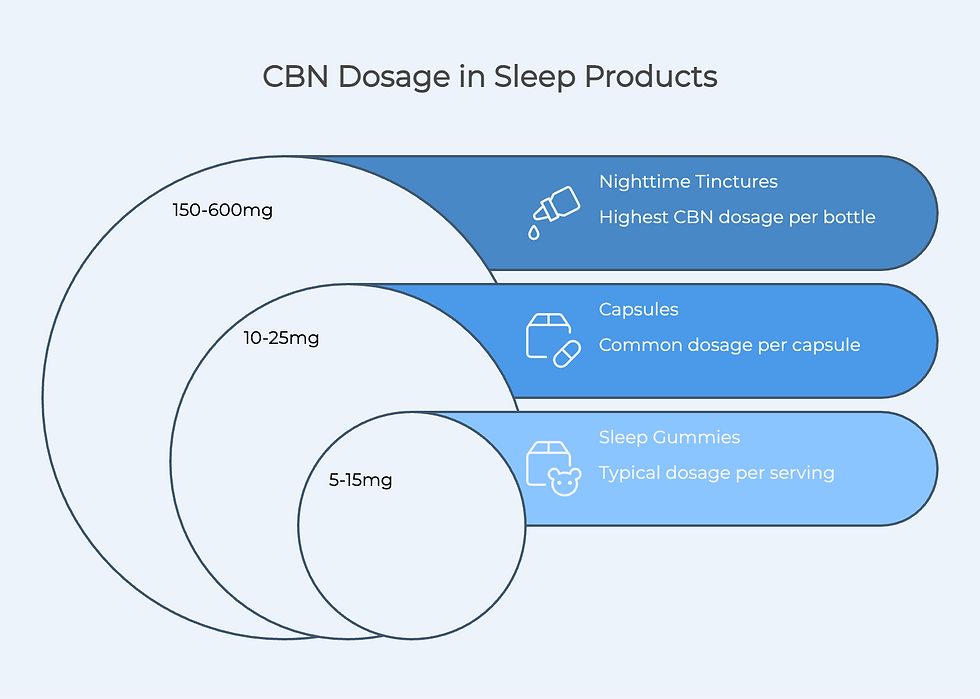
Sleep Gummies: Typically dosed at 5–15mg CBN per serving, often combined with melatonin or L-theanine. Manufacturers report strong consumer retention on CBN-based sleep SKUs compared to melatonin-only formulations.
Nighttime Tinctures: PM tinctures typically feature 150–600mg CBN per bottle. The isolate format enables precise, THC-free dosing that meets mainstream retail standards.
Capsules: 10–25mg CBN per capsule is common in pharmaceutical-style sleep supplements targeting consumers who want a non-habit-forming alternative.
Topicals: CBN appears in nighttime balms and massage oils at 0.5–2% concentration, often combined with calming botanicals for evening skincare positioning.
Closing Thoughts: How Arvida Labs Can Support Your CBN Formulation
CBN is one of the more technically demanding ingredients in the current cannabinoid market. Its production requires controlled chemistry, multi-stage purification, and documentation that holds up under regulatory scrutiny — and the window between a supplier that can actually deliver all of that and one that simply says it can is wider than most buyers realize until they're mid-production.
At Arvida Labs, we supply CBN isolate to brands building in the sleep and relaxation category, with full-panel COAs, batch traceability, and consistent 99%+ purity. Whether you're developing a new nighttime SKU, reformulating an existing product, or scaling a line that's already in market, the supply chain behind your CBN ingredient matters as much as the formulation itself.
If you're ready to evaluate sourcing options or want to discuss the specifics of a CBN-based formulation, Arvida Labs is here to help. Get in touch with our team to learn more today.
Frequently Asked Questions
Is CBN Legal Under the 2018 Farm Bill?
CBN derived from hemp-sourced CBD or CBGa is federally legal under the 2018 Farm Bill, provided the final product contains less than 0.3% delta-9 THC by dry weight. CBN itself is not scheduled as a controlled substance. However, starting material matters. CBN produced from THC-rich cannabis may face different regulatory treatment depending on the facility and state.
How Does CBN Compare to CBD in Terms of Effects?
CBD and CBN are both non-intoxicating, but they operate through different mechanisms. CBD has a broader effect profile spanning anxiety, inflammation, and general wellness. CBN has weaker CB1 affinity than THC but stronger CB2 activity than CBD, and its primary commercial positioning is in sleep and nighttime recovery. The two are frequently combined in PM formulations.
What Purity Should I Expect From Commercial CBN Isolate?
Pharmaceutical and formulation-grade CBN isolate should test at 98–99%+ cannabinol concentration with non-detectable THC. Any batch below 97% warrants scrutiny around the supplier's purification process. Full-panel COAs, covering potency, heavy metals, pesticides, residual solvents, and microbials, should accompany every production batch.
Can CBN Be Made From Hemp-Derived CBD Without Using THC?
Yes. The iodine-catalyzed CBD-to-CBN conversion method produces CBN from hemp-derived CBD without requiring THC as a starting material. This is the most common commercial route for hemp-compliant CBN production, and it keeps the full process within Farm Bill parameters when executed correctly.
What Products Is CBN Isolate Most Commonly Used In?
Sleep gummies, nighttime tinctures, PM capsules, and relaxation topicals are the primary formats. CBN is most often positioned as an evening or sleep-support ingredient. It's frequently combined with CBD, melatonin, or L-theanine in formulations targeting consumers who want non-pharmaceutical sleep support.
How Do I Verify a CBN Supplier's Quality Before Committing?
Request batch-specific COAs, not generic product certificates, that show potency, heavy metals, pesticides, residual solvents, and microbial counts. Ask for COAs across multiple production batches to verify consistency, not just a single clean result. Confirm whether the supplier owns the conversion process or is reselling from a third party, and ask directly about their starting material and purification method.
Sources for This Article
Google Patents: "US9730911B2 - Methods for producing purified cannabidiol from cannabis plant material" - patents.google.com/patent/US9730911B2/en
Wikipedia: "Cannabinol" - en.wikipedia.org/wiki/Cannabinol
United Nations Office on Drugs and Crime: "The isolation of cannabidiol and cannabinol from cannabis" - unodc.org/unodc/en/data-and-analysis/bulletin/bulletin_1997-01-01_1_page008.html
Google Patents: "US20220002261A1 - Methods of preparing cannabinoid compounds" - patents.google.com/patent/US20220002261A1/en
PubMed: "Pharmacokinetics and metabolism of cannabidiol and its main metabolites" - pubmed.ncbi.nlm.nih.gov/37796540/
PubMed: "The anti-biofilm activity of cannabinoids against methicillin-resistant Staphylococcus aureus" - pubmed.ncbi.nlm.nih.gov/40844832/


Mobile wallets have been quietly reshaping how people move funds around, and Apple Pay is one of the more predictable examples in Norway since its rollout back in 2018 through Nordea and Santander, later expanding to most local banks. From a technical angle what stands out is the tokenization layer, since the actual card details never reach the receiving party, only a one time cryptogram, which reduces exposure compared to typing card numbers manually. Anyone comparing platforms that list this option can cross check details on www.applepaycasino.no against the bank's own documentation, because support still varies between operators. Speed of processing tends to be consistent, but availability depends on the merchant side, not on Apple itself. Just an observation from following…